The 2026 Grain Season – Mild temperatures leading up to harvest top up potential grain yields
Even though September rain was light on in areas away from the Great Southern and Esperance, temperatures were below average allowing crops to slowly fill potential yields where subsoil moisture was available. Mild temperatures during grain fill do not have quite the same impact as rainfall, but without substantial heat shock during grain fill, crops usually end up yielding more than appearances suggest.
There were several days near the end of September where temperatures nudged 30°C with hot winds, scorching crops and sending them white overnight. However, the majority of crops seemed to push through this and have benefited from the slow dry down.
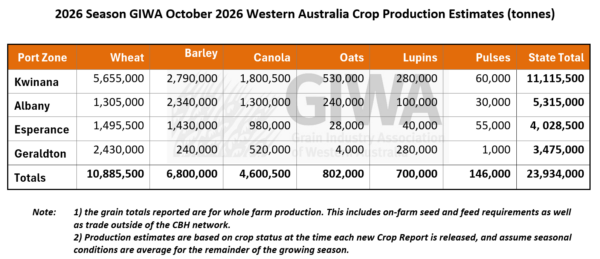
The outcome of this will likely be a lift in total grain production for the state from last month’s Crop Report.
Grain quality in cereals is likely to be all over the place with high screenings where crops ran out of moisture, to good weights where the crops were less impacted. There is likely to be a high variance in protein from the array of fertiliser strategies employed during the year as growers juggled decision making around restricted nitrogen availability and high cost, along with the difficulty of estimating the impact the long dry spell experienced in May and early June would have on overall yield potential.
The recent mild temperatures will benefit wheat the most, particularly the later emerging crops. All crops in the low growing season rainfall strip from the western Kwinana South port zone down through the eastern portion of the Albany port zone will also benefit from the rain in early September and mild conditions through the majority of the month and into early October.
The only significant drop in potential production from last month is the issue of poor pod development in many canola crops across the state. Poor pod set on the main raceme is going to take the top off potential yields in those crops most affected, and the widespread nature of this impact will keep a lid on total canola production.
Early harvest grain yield results coming in from Geraldton and Esperance are very good, although skewed as growers hop into the best paddocks first. Even so, Esperance is going to have near record tonnages and the better areas and soil types in the Geraldton port zone are going to be very good. The central regions of the Kwinana port zone are going to be near record yields and the lower rainfall regions of the Kwinana East port zone are also going to be very good. The western areas of the Albany port zone are going to be solid again, as are the south coastal regions.
Seasonal Outlook
Meredith Guthrie, Department of Primary Industries and Regional Development

Climate summary
Rainfall across the South West Land Division (SWLD) has been very variable. Since 1 January to 11 October 2026, DPIRD’s weather station at Coomalbidgup (in Esperance shire) has had 589 mm, while the Bureau of Meteorology Kukerin Post Office weather station (in Dumbleyung shire) has only recorded 167 mm (Figure 1). The rainfall since the start of the year has been below decile 3 for much of the Great Southern and decile 8-9 for parts of the northern and central grainbelt and Esperance and Ravensthorpe shires (Figure 2). The French and Schultz potential yield map uses rainfall data from 1 April to 11 October 2026 and assumes a decile 5 rainfall from 12 to 31 October 2026, with a WUE value of 20 kg/ha/mm and evaporation rate of 110 mm. The lowest yield potential is 1t/ha at Broomehill.
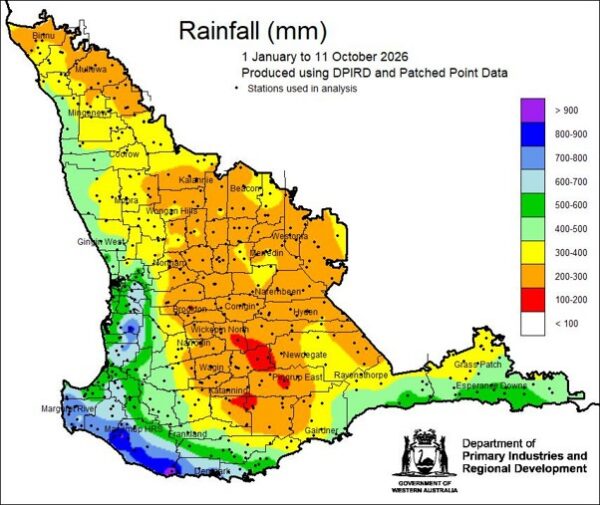
Figure 1: Rainfall (mm) from 1 January to 11 October 2026 for the SWLD. Coomalbidgup has the highest total of 589 mm and Kukerin has the lowest total with 167 mm.
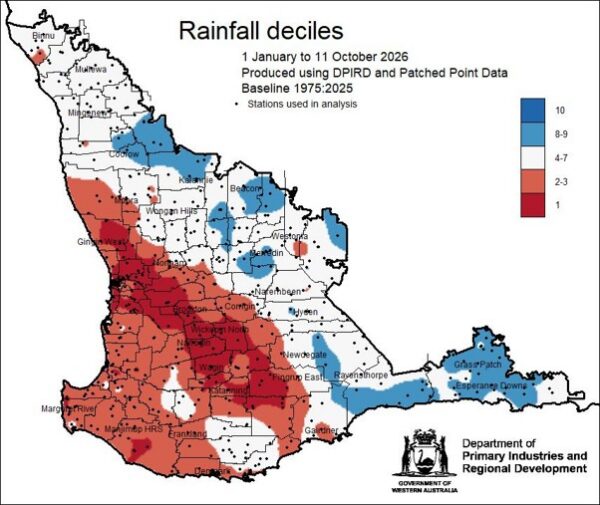
Figure 2: Rainfall deciles from 1 January to 11 October 2026 for the SWLD. Indicating variable rainfall throughout the SWLD.
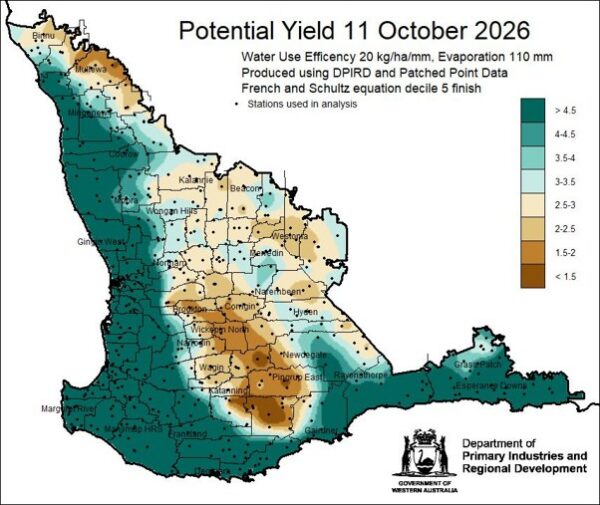
Figure 3: Potential yield map using rainfall up to 11 October 2026 with decile 5 finish for 12-31 October for the SWLD. This map uses French and Shultz calculation using water use efficiency of 20 kg/ha/mm and evaporation of 110 mm. The lowest yield potential is 1t/ha at Broomehill.
Forecast
The November 2026 to January 2027 rainfall outlook from the Bureau of Meteorology ACCESS model shows an increased chance of rainfall being in the highest 20 per cent of the historical range for the southern part of the grainbelt.
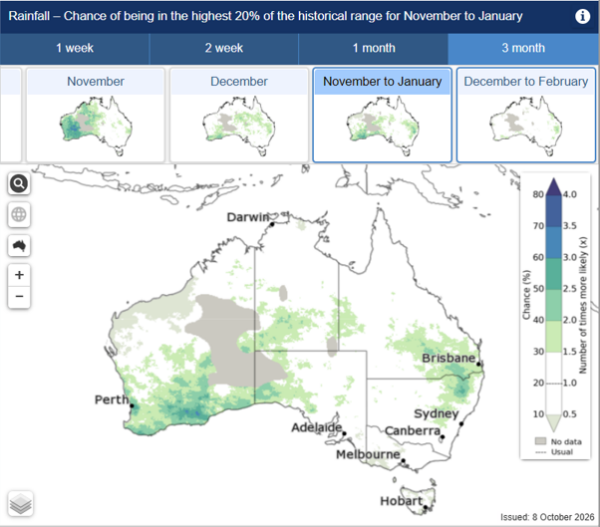
Figure 4. Chance of rainfall being in the highest 20% of the historical range for November 2026 to January 2027 for Australia from the Bureau of Meteorology’s ACCESS model. Indicating that rainfall is expected to be wetter than normal for the southern part of the grainbelt.
The El Niño in the Pacific Ocean is expected to persist into autumn 2027. An El Niño over spring/summer increases the risk of bushfires. The wetter rainfall outlook for November 2026 to January 2027, may increase weed burden and allow a green bridge to persist into autumn 2027, potentially increasing the carry-over and spread of pests and diseases.
Temperature
In September, maximum and minimum temperatures were above average to very much above average across the SWLD, with little to no frost recorded. The highest temperature recorded in September was at DPIRD weather station at Salmon Gums with 36.3 °C.
Temperature outlooks are for warmer than normal temperatures expected into summer 2027. An El Niño during spring and summer can lead to higher temperatures, more frequent heatwaves and an increased risk of bushfire.
Additional information is available from:
- DPIRD: Weather stations
- DPIRD: Soil Water Tool
- DPIRD Rainfall to Date Tool
- DPIRD Seasonal Climate Outlook newsletter
- BoM: Rainfall totals for cool season 2025/26
- BoM: Rainfall outlook for the next week
- BoM: Seasonal Rainfall Outlook
- BoM: Australian Water Outlook
Geraldton Zone
It’s early days in the region with harvest slowly getting underway on the early March/April-sown crops. It is mostly canola that has been harvested so far with grain yields very good and oil percentages in the high 40’s. Not a lot of wheat has come off yet, although early sown wheat on fallow country is exceptional with yields in the 4.0 t/ha plus range and protein in the high 11 to low 12 percent range.
The corridor from Watheroo, Coorow, Carnamah to Three Springs in the north Midlands region is also producing excellent grain yields. The crops north of Mingenew tail off, then improve through Northampton but fall away again in the far northern areas. The far eastern line east of Mullewa, Canna, Morawa and down to Perenjori is very poor, with many of those areas having received 130 mm or less of growing season rainfall.
In between the good and the poor areas, the yield results are expected to be highly dependent on timing of emergence. There is likely to be a big difference in grain yields between those crops that emerged in May and those that emerged in June, with the May emerged crops expected to significantly outyield those that emerged in June. That difference will be more pronounced this year than in other years.
The region is quite varied in crop grain yield potential from north to south and west to east, even so the port zone should end up with about 3.5 million tonnes of total grain, which puts it up there with some of the historically best years for the zone.
Kwinana Zone
Kwinana North Midlands
Harvest activity has only just started with no actual yields to report. The medium to heavy country to the east is expected to yield well, but the lighter sandplain country did suffer from the lack of any useful rain in September and is expected to have taken a dive in potential yield over the last month.
The lighter sandplain soils were badly hurt during September with virtually no useful rain for most growers. The dry September has definitely "taken the shine off" crops and in many cases the lighter soils have "fallen apart". The few early October rains have helped keep sandplain crops in the game, although the contribution is more likely to be quality-related than via a meaningful yield uplift.
Barley crops are finished now and looking good in most areas, so grain yields should be solid. Canola is going to be okay overall, but pod abortion is clearly visible. There are empty and distorted pods evident as you wander through paddocks which will take the shine off yields, but growers are still expecting a solid canola year.
Barley crops are very good and potentially near the top end of historical grain yields. Virtually no wheat has been harvested to date. The later sown wheat paddocks did suffer from the hot winds near the end of September, and many went ghost white overnight, which is never a good thing.
So far canola crops are very good, although the top has been taken off many from poor pod set on the main raceme. This widespread phenomenon has tended to keep yields at expected levels rather than push them higher, as is the case with the cereals from the last Crop Report. Bugs in canola did require quite a bit of managing late during grain fill, with most growers opting to continue to spend rather than shut the gate, which can sometimes be the case in these lower rainfall, lower yielding regions.
There has been more sclerotinia and upper canopy blackleg than normal in canola, and more sclerotinia in pulse crops in the region due to the early planting and ideal moist warm conditions in July and early August. The dry September did as good a job as fungicides in pulling up the leaf diseases, and as crops are routinely and actively managed for sclerotinia and blackleg, the impact on crops has been minimal.
Lentils are performing well where two sclerotinia fungicide sprays were applied. Upper canopy blackleg is slightly elevated in canola paddocks where only one fungicide was applied, with early and aggressive sclerotinia spray strategy appearing to reduce upper canopy blackleg incidence. Fungicide product selection is important with products with longer residual activity (five–six weeks) significantly outperforming shorter-residual products (three weeks) over extended flowering periods. Asking a three-week product to cover six or seven weeks is unrealistic and usually results in higher infection levels.
Kwinana South
There are no real harvest results to report yet. Only a few barley paddocks have been harvested, which is not enough to make meaningful comment.
The eastern shires are a standout for the zone with the region bracing itself for record crops in the central and eastern regions of the zone. The “out of the blue” rain in late August followed by another lick of rain around the AFL Grand Final day in September has resulted in pushing the earlier emerged crops to their maximum estimated potential yields and substantially helped out with grain fill in the later finishing crops. Grain yields will be up there with the record year of production in 2022 for all cereal crops.
The Merredin and Kellerberrin CBH receival zones are considered the sweet spot, and wheat crops south of those two bins are looking in "absolutely magnificent shape" for potential.
Unfortunately, a lot of canola crops won’t hit these high yields as the lack of pod set on the main raceme on several of the popular varieties will put a lid on top end potential. Many crops that should be in the 2.5 t/ha range will likely end up closer to 2.0 t/ha.
The incidence and severity of sclerotinia in canola was high during the winter and spring with the late rainfall events in late July and early August creating ideal disease expression conditions, exceeding levels previously seen in the region. Both aphids and grubs in canola were rampant, and all canola crops were sprayed at least once.
Grain yields in the western areas of the zone were short on water all year which has limited the grain yield potential of all crops. Many of the bigger biomass cereal crops sweated off yield and baked during the warm days at the end of September, with both barley and wheat crops going white overnight. The region will still produce a good result but won’t be breaking recent records.
Kwinana North East
The region largely missed out on finishing rains in September which would have pushed production to “best ever”, however, thanks to the mild finishing temperatures and early emergence of crops being less exposed to the need for rain in September it is still going to be a very good year for most growers.
Canola harvested around Goodlands on fallow has been going between 2.2 and 2.4 t/ha and while still early days, it is expected that most of the early sown canola on fallow across the zone will hit these very high grain yields for the region. The remainder of the canola crops on cereal stubbles in the region will likely be in the 1.2-1.5 t/ha range when the impact of heat, lack of September rain and lack of pod set on the main raceme is taken into account. This is disappointing, as most were set up to yield much better than this.
A few lentil paddocks have been harvested around Southern Cross and are going in the high 1 t/ha to low 2 t/ha range.
Expected barley grain yields have slipped a little from the low 4 t/ha to approximately 3.5 to 3.7 t/ha range, which is still a very good result if realised. All year, barley crops have easily looked to be in the 4 t/ha range, although heads have tapered off to small grain near the top, reducing weight and increasing screenings.
Ironically, wheat crops appear less affected than barley from the dry September. This is probably due to having been sown later, which meant there was less biomass and a little more moisture in reserve for grain fill. Many wheat crops were still green two weeks ago and the lack of heat since then will likely result in an uptick in tonnage right across the zone at harvest.
There will be some outstanding individual results possible in some paddocks, particularly those sown on fallow. The general sentiment from growers is it will be an above average year for most and since it is good all across the zone, there will be a lot of grain produced in the region despite the lack of finishing rains.
Albany Zone
Albany West
The region is still a few weeks off commencing harvest as late rains have tended to keep crops green while the rest of the state dries down. The lower than average and spread-out rainfall in the region has meant less waterlogging than normal, allowing the lower lying areas to contribute grain. This will push up whole paddock averages.
The AFL Grand Final weekend rain event of 40 to 50 mm that fell across Ongerup and Jerramungup assisted those dry areas as crops were behind from a later start. The rain arrived too late to benefit canola and barley, which had already been swathed or desiccated approximately two weeks prior. But wheat crops which were filling heads at the time will definitely benefit.
The dry September has taken some shine off the heavier crops which were starting to run out of moisture. Crop grain yields will still be solid without being record breaking.
The eastern regions of the zone have had wide variations in rainfall all year and grain yields will reflect this. Examples of rainfall around Jerramungup varying from 200 mm to 285 mm within a short distance are common. The grain yield variation in cereals could be from 1.5 t/ha to 4 t/ha depending on the combined influence of time of emergence and rainfall.
The canola pod set problem seen across the state is also evident in the region, but it is likely to have less impact as there is more time for crops to compensate. As a result, canola grain yields will be good.
Albany South
Harvest is still a week or two off, as even though canola crops have been swathed for a couple of weeks, the weather has been relatively cool, slowing down the dry down period.
Canola yields are expected to be more variable than usual this year, due to a greater spread in emergence dates, total rainfall, timing of rainfall and some lost potential from pod loss.
Barley grain yields away from the coast will also be highly variable with some crops nearly dying and re-shooting whilst others will hit 3 to 4 t/ha, depending on where they were in relation to the early rain and follow up rainfall. Closer to the coast, barley crops will be in the usual 4.5 to 6 t/ha range.
Wheat crops received the late rains just in the nick of time to assist in grain fill. Many look good from the road although head numbers are low when counted. The coastal crops will be very good.
Lupins and beans crops in the low rainfall areas will range from unharvestable from being too short, to very good in the western and south coastal areas.
Albany East (Lakes Region)
Grain production in the Lakes region will reflect the rain received over winter, with the north and eastern areas good, tapering off to poor in the western and southern regions. There has been some respite recently with rain falling in the poor areas, which will help those late crops and kick yield potential slightly.
The absence of significant frost events this year has once again meant the region will not take the hit in yield that it so often has in years gone by.
Canola area has been creeping up in the region, and most crops will be good rather than very good. Barley crops will yield very well in the better areas and wheat will be very good in the line from Kondinin to Kulin and further east down to Newdegate.
Esperance Zone
The zone has not been dry since February and the rain kept coming through September and early October. The couple of hot days in September knocked crops around a little, although the whole zone is looking forward to a very good harvest. Rainfall has not been a limiting factor all year, the only challenges have been keeping a lid on leaf diseases and pests.
Early canola harvest results are sitting between 2.2 and 3.6 t/ha with oil content between 45 to 47 per cent. The best result reported so far is from West Munglinup where approximately 1,000 ha yielded an average of 3.2 t/ha. These early high yields don’t necessarily follow through to the end of harvest as the poorer paddocks are usually left until last. Even so, it does point to what is ahead for the region.
Barley crops that were well managed for leaf diseases will be exceptional and the wheat crops have finished well due to the mild spring conditions. Both should hit close to genetic grain yield potential.
There has been an expansion in canola area in 2026 in the Mallee and the likely grain yields in the 2.0 t/ha range this year as opposed to long term averages in the low 1.0 t/ha range will give a strong confidence boost for canola in the region.
Approximately 40 per cent of paddocks that would traditionally be in field peas, brown manure, vetch or fallow switched to canola this season. Following the early break opportunity this early sowing is going to yield results and even though it has been a very good rainfall year, it points to significant practice change for the future.
Sclerotinia infection in canola has been unprecedented in both severity and geographic extent for the Esperance zone, appearing in places and at levels never previously seen, including as far north as Salmon Gums. This will return enormous amounts of sclerotia back into the soil across the Esperance zone. One which in warm, wet winter further down the track will cause problems to resurface at a scale not yet seen in the region. It only takes one recharge year to significantly reload the system, as has been found in regions to the north.
Upper canopy blackleg and Alternaria are both present in canola even where fungicides were applied. Both will be a concern in the future as more canola is grown and on tighter rotations. On a positive note, growers have been enquiring more about blackleg resistance groups and fungicide management strategies than in the past and there seems to be a genuine mindset shift occurring in actively managing these diseases.