Skip to content

Grain Industry of Western Australia

Main Navigation

  • Home
  • About Us
    • About Us

      The Grain Industry of Western Australia

      GIWA is a not-for-profit, whole of value chain member industry association incorporated under the WA Associations Incorporation Act 2015.

      • Our Story
      • Councils
      • Board
      • Board Past Chair
      • Team
      • Current Members
      • Join GIWA
  • News
    • News

      The Grain Industry of Western Australia

      Catch up on all the latest news from GIWA, a not-for-profit, whole of value chain member industry association.

      • Latest News
      • GIWA Annual Reports
      • Media Announcements
  • Events
    • Events

      The Grain Industry of Western Australia

      GIWA is a not-for-profit, whole of value chain member industry association incorporated under the WA Associations Incorporation Act 2015.

      • Upcoming Events
      • GRDC Grains Research Updates
      • GRDC Farm Business Updates
      • Past Events
  • WA Crop Reports
    • WA Crop Reports

      The Grain Industry of Western Australia

      GIWA is a not-for-profit, whole of value chain member industry association incorporated under the WA Associations Incorporation Act 2015.

      • 2026 WA Crop Reports
      • 2025 WA Crop Reports
      • 2024 WA Crop Reports
      • 2023 WA Crop Reports
      • 2022 WA Crop Reports
      • 2021 WA Crop Reports
      • 2020 WA Crop Reports
      • 2019 WA Crop Reports
      • Previous WA Crop Reports
  • Industry Projects
    • Industry Projects

      The Grain Industry of Western Australia

      GIWA is a not-for-profit, whole of value chain member industry association incorporated under the WA Associations Incorporation Act 2015.

      • Industry Partners
      • Strategic Priorities for WA Grains Industry 2035
      • Grain Receival Standards
      • Malt Barley Variety Receival Rationalisation
      • Processed Oat Partnership
      • COGGO Research Fund
  • Calendar
  • Contact Us
    • Contact GIWA

      The Grain Industry of Western Australia

      GIWA is a not-for-profit, whole of value chain member industry association incorporated under the WA Associations Incorporation Act 2015.

      • Contact Us
      • Grain Trade Enquiries
      • Job Enquiries
  • About Us
    • Our Story
    • GIWA Board
    • GIWA Board Past Chair
    • GIWA Team
    • Join Us
  • GIWA’s Commodity Councils
    • Barley Council
    • Oat Council
    • Oilseeds Council
    • Pulse Council
    • Wheat Council
  • Events
    • GIWA Events
    • GRDC Research Updates
    • GRDC Farm Business Updates
    • Past Events
  • News
    • Latest News
    • Media Announcements
    • GIWA Annual Reports
  • Industry Projects
    • Industry Partners
    • Strategic Priorities for the WA Grains Industry 2035+
    • Grain Trading Standards
    • Malt Barley Variety Receival Rationalisation
    • Processed Oat Partnership (POP)
    • COGGO Research Fund
  • WA Crop Reports
    • 2026 Season
    • 2025 Season
    • 2024 Season
    • 2023 Season
    • 2022 Season
    • 2021 Season
    • 2020 Season
    • 2019 Season
    • Previous Years Crop Reports
  • Contact Us
    • Contact Us
    • Grain Trade Enquiry
    • Job Enquiry
  • Home
  • About Us
    • About Us

      The Grain Industry of Western Australia

      GIWA is a not-for-profit, whole of value chain member industry association incorporated under the WA Associations Incorporation Act 2015.

      • Our Story
      • Councils
      • Board
      • Board Past Chair
      • Team
      • Current Members
      • Join GIWA
  • News
    • News

      The Grain Industry of Western Australia

      Catch up on all the latest news from GIWA, a not-for-profit, whole of value chain member industry association.

      • Latest News
      • GIWA Annual Reports
      • Media Announcements
  • Events
    • Events

      The Grain Industry of Western Australia

      GIWA is a not-for-profit, whole of value chain member industry association incorporated under the WA Associations Incorporation Act 2015.

      • Upcoming Events
      • GRDC Grains Research Updates
      • GRDC Farm Business Updates
      • Past Events
  • WA Crop Reports
    • WA Crop Reports

      The Grain Industry of Western Australia

      GIWA is a not-for-profit, whole of value chain member industry association incorporated under the WA Associations Incorporation Act 2015.

      • 2026 WA Crop Reports
      • 2025 WA Crop Reports
      • 2024 WA Crop Reports
      • 2023 WA Crop Reports
      • 2022 WA Crop Reports
      • 2021 WA Crop Reports
      • 2020 WA Crop Reports
      • 2019 WA Crop Reports
      • Previous WA Crop Reports
  • Industry Projects
    • Industry Projects

      The Grain Industry of Western Australia

      GIWA is a not-for-profit, whole of value chain member industry association incorporated under the WA Associations Incorporation Act 2015.

      • Industry Partners
      • Strategic Priorities for WA Grains Industry 2035
      • Grain Receival Standards
      • Malt Barley Variety Receival Rationalisation
      • Processed Oat Partnership
      • COGGO Research Fund
  • Calendar
  • Contact Us
    • Contact GIWA

      The Grain Industry of Western Australia

      GIWA is a not-for-profit, whole of value chain member industry association incorporated under the WA Associations Incorporation Act 2015.

      • Contact Us
      • Grain Trade Enquiries
      • Job Enquiries
Home›News›The WA Malt Barley Variety Receival Recommendations for the 2027/28 harvest

The WA Malt Barley Variety Receival Recommendations for the 2027/28 harvest

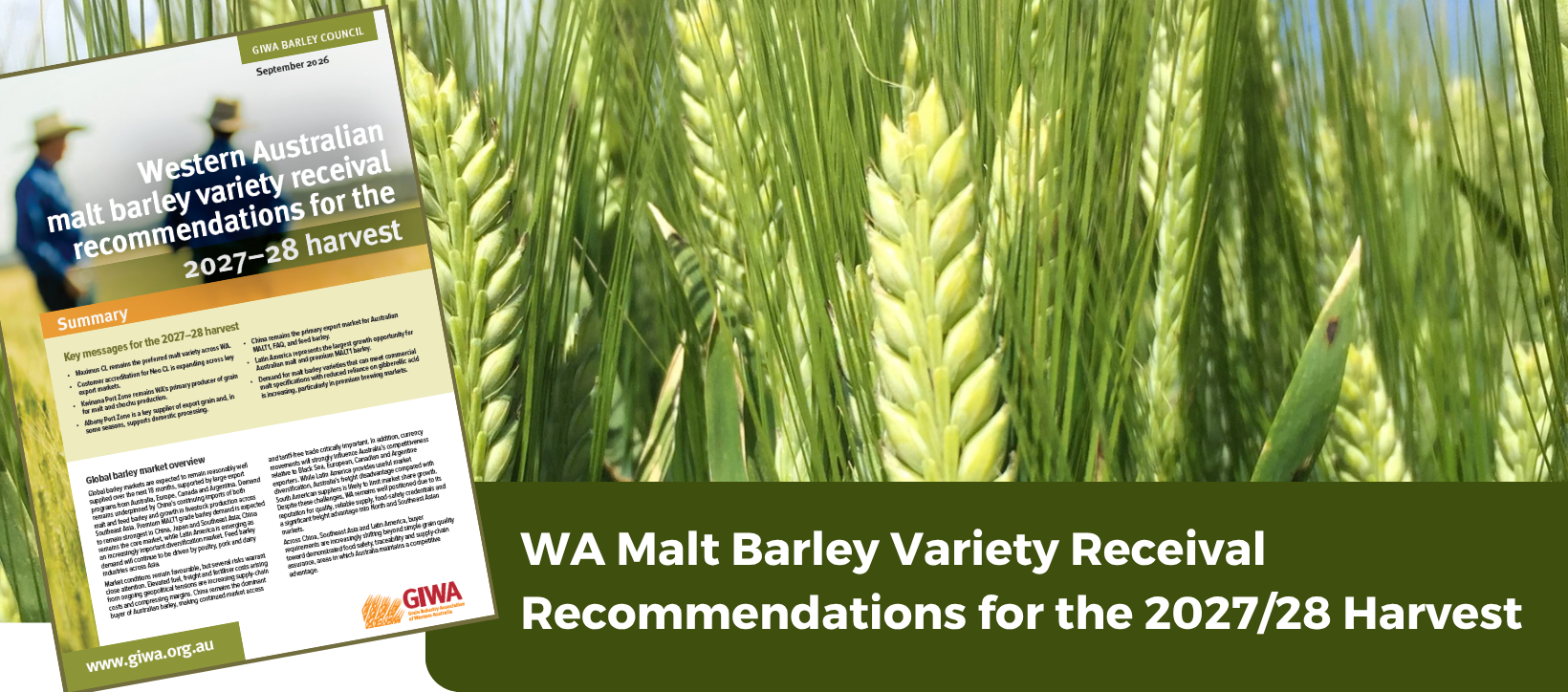
To assist growers and consultants in planning their next barley crop, the Grain Industry Association of Western Australia (GIWA) has been producing the WA Malt Barley Variety Receival Recommendations each year for the past 15 years.  Today GIWA released the latest edition ahead of the state’s 2027 barley cropping program.

Developed by the GIWA Barley Council in consultation with the WA barley supply chain, the annual plan provides WA barley growers with guidance on which malting varieties are both sought by the market and agronomically suited to WA, and which therefore will likely be segregated by CBH.  It also flags varieties for which opportunities may exist for niche segregations or direct grower-to-buyer contracting.

In 2026 Maximus CL dominated barley plantings, accounting for almost two-thirds of the state’s barley area in 2026 and becoming the largest segregation within the CBH network at the 2025–26 harvest. Neo CL was the second most widely grown variety in 2026, representing just over one in every six hectares planted to barley and achieving strong adoption in the Kwinana and Albany Port Zones.

However, Peter Nash, GIWA CEO says that while the dominance of Maximus CL & Neo CL is understandable given their agronomic performance and resultant strong uptake by growers, this presents challenges for WA’s ability to meet market expectations.

“Global maltsters continue to seek barley varieties that deliver specific malt functionality, processing efficiency, and brewing performance but in WA, the limited diversity in segregated varieties and the low availability of malting-suitable barley that doesn’t require processing aids are constraining global demand for WA malt barley grain and malt.  So, maintaining access to premium markets will require ongoing investment in breeding varieties that combine agronomic performance with superior malting quality characteristics,” said Peter.

This year’s plan sees segregation opportunities for Maximus CL and Neo CL varying by port zone except for Geraldton where no segregation has been recommended.

This year’s plan also sees Cyclops and Laperouse, which in 2025 were added to the list of varieties for which segregations could be offered in 2026/27, fall off the list.  Limited domestic malting demand and a lack of export market pull from either WA or eastern Australia for these two varieties mean segregations are not expected for the 2027–28 harvest.

Similarly, declining RGT Planet production has reduced volumes below the threshold required to justify segregation within the bulk handling system. While niche procurement pathways, including on-farm storage and smaller bulk handling facilities may continue to support domestic demand for RGT Planet, the CBH network will not offer segregation for the 2027–28 harvest.

Global barley markets are expected to remain reasonably well supplied over the next 18 months, supported by large export programs from Australia, Europe, Canada and Argentina.  Demand remains underpinned by China’s continuing imports of both malt and feed barley and growth in livestock production across Southeast Asia.

Premium MALT1 grade barley demand is expected to remain strongest in China, Japan and Southeast Asia.  China remains the core market, while Latin America is emerging as an increasingly important diversification market.

Feed barley demand will continue to be driven by poultry, pork and dairy industries across Asia.

Across China, Southeast Asia and Latin America, buyer requirements are increasingly shifting beyond simple grain quality toward demonstrated food safety, traceability and supply-chain assurance, areas in which Australia maintains a competitive advantage.

Industry reports suggest many Chinese brewers are increasing malt inclusion rates in mainstream beer formulations as part of broader premiumisation trends. If fully implemented, this could increase annual MALT1 barley demand by around 1 million tonnes while reducing reliance on FAQ (fair average quality) barley.

International market signals continue to highlight Australian malt barley’s generally low protein status. GIWA’s Malt Barley Variety Receival Recommendations plan says growers can help remedy this by targeting malt barley grain between 10.3-10.8% protein for varieties favoured by domestic maltsters and 10.5-11.0% for varieties favoured for export sales, even though the receival window is 9.5-12.8%.

Seven varieties are currently in Stage Two of the Grains Australia Malt Accreditation Program and have not been included in the WA Malt Barley Receival Recommendations for 2026-27. Growers should expect a decision on the malt accreditation of AGT-Bunyip IA, AGT-Spirit and Titan AX in March 2027 and March 2028 for RGT Atlantis, Rocket CL, Soldier CL, Spinnaker. It’s important to note that malt accreditation does not guarantee segregation opportunities at the receival sites.

“Each year, the GIWA Barley Council works with the WA barley value chain to provide guidance to industry on the management of malt barley segregations in the bulk handling system,” Peter said.

“I strongly encourage growers and their consultants to take note of the recommendations within the plan when considering their 2027 barley cropping program.”

For more information on the WA Malt Barley Variety Receival Recommendations for 2027/28 harvest, please click here
Follow us

For all the latest news and updates from the Western Australian Grain Industry.

Grain Industry of Western Australia

GIWA - Facilitating an effective and efficient Western Australian Grain Industry.

Grain Industry Association of Western Australia

Contact Us

Phone: 08 6262 2128
Email: [email protected]

Suite 1
125 Melville Parade
COMO WA 6153

  • About Us
    • Our Story
    • GIWA’s Commodity Councils
    • Current Members
    • Join Us
    • GIWA Board
    • GIWA Board Past Chair
    • GIWA Team
  • News
    • Lastest News
    • GIWA Annual Reports
    • Media Announcements
  • Events
    • Upcoming Events
    • GRDC Research Updates
    • GRDC Farm Business Updates
    • Past Events
  • WA Crop Reports
    • 2026 Season
    • 2025 Season
    • 2024 Season
    • 2023 Season
    • 2022 Season
    • 2021 Season
    • 2020 Season
    • 2019 Season
    • Previous Years
  • Industry Projects
    • Industry Partners
    • Strategic Priorities for the WA Grains Industry 2035+
    • Grain Trading Standards
    • Malt Barley Variety Receival Rationalisation
    • Processed Oat Partnership (POP)
    • COGGO Research Fund
  • © Grain Industry Association of Western Australia 2026.
  • Disclaimer
  • Privacy Policy
  • madebyloaded