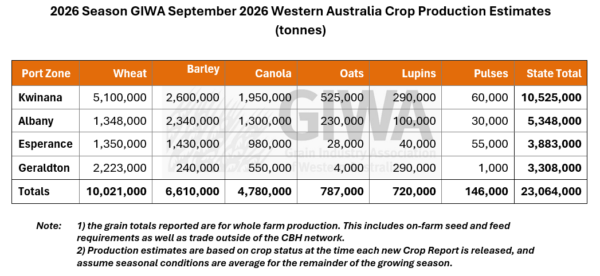
The 2026 Grain Season – The Western Australian grain crop potential has improved over the last month pushing production estimates back up to over 23mt of total grain
The estimated grain crop potential slid rapidly following the last Crop Report in early August with the continued dry weather. Many crops were running out of subsoil moisture and grain yield potential was dropping by the day. This slide was halted in most areas in the last week of August with a non-traditional “cut-off” low pressure system dropping buckets of water in the central regions of the state and useful falls in areas away from the epicentre of the low. As a result of this rainfall event crop yield potential in the state over the last four weeks is now above what the crop was looking like when the last report came out in early August.
Most of the very good rainfall totals were recorded in the central regions of the grainbelt. The west Midlands and the majority of the Kwinana North zone also received good rains from this weather system. The western end of the Esperance zone and west Albany picked up useful falls of rain around the same time. The northern zones missed most of this as did the corridor from south of Brookton through to Bremer Bay that has unfortunately been missing out all year. Crops that received upwards of 50 mm in August are now likely to yield closer to what their potential was at the end of July, instead of the much lower potential they were showing in the middle of August just prior to the rain.
Heat has now taken over as the biggest limiting factor to grain yield and with the easterlies blowing hot air across the grainbelt with little rain forecast to follow, the growing season is in for a sharp finish.
It looks as though the risk of frost has abated as the next few weather systems coming through do not have a cold air mass behind them, which is more typically the case in spring. Frost has not been a significant factor anywhere this year and due to the advanced stage of most crops, it is now unlikely to be as most crops are now outside the frost risk window. This has contributed to the uptick in potential tonnage for the Western Australian grain crop between August’s Crop Report and this September edition. .
Crops in the north of the state are too advanced for rain over the next few weeks to have any positive impact on yield. Their yield potential will be determined more by the onset of heat. If the cold front forecast for this coming weekend follows this year’s pattern of slipping away without delivering much rain, it will be too late to add tonnes in most of the regions except the south coast and west Albany zones.
Grain quality is likely to be quite varied depending on the region. In areas such as Esperance, west Albany, the Midlands and the eastern and central Kwinana zones, grain yields are going to be limited by nitrogen. Yield will be left in the paddock and even though grain size in cereals will be good, protein is expected to be down. In the northern zones and the drier areas of the Kwinana and Albany zones, yield will be limited more by rainfall than nitrogen and protein should be good in the cereals.
In summary, without the eleventh-hour rain at the end of August, we were looking at a very ordinary year as far as production goes. We are now going into harvest in many areas with reasonable grain yield prospects more in line with what the crop was looking like at the end of winter.
It’s interesting to note the change in landscape over the last ten years particularly in the low rainfall regions where it was once wall-to-wall wheat. This year 47 per cent of the state’s total canola area is in the low to medium rainfall regions. This has been driven by profitability and consistency of yield. A good example of this is in the Yilgarn shire where there is 177,000 ha of wheat, 64,000 ha barley and 59,000 ha canola this year. In Ravensthorpe shire there is 112,000 ha of canola, 91,000 ha of wheat and 52,000 ha of barley. In the higher rainfall regions, it’s pretty well year-in-year-out cereal/canola.
This increase in canola area and tonnage brings with it a lift in profitability for WA growers and opportunities for increased global market share due to consistent production levels. WA is now consistently producing 50 per cent of Australia’s canola. It also brings with it greater production risk as the canola area increases and rotations become tighter. The challenge ahead is to balance all the agronomic and cultural practices available in a sustainable manner to keep WA’s most profitable crop profitable.
Seasonal Outlook
Meredith Guthrie, Department of Primary Industries and Regional Development

Climate summary
Rainfall across the Southwest Land Division (SWLD) has been very variable. Since 1 January to 13 September 2026, DPIRD weather station Coomalbidgup (in Esperance shire) has had 534 mm, while the Bureau of Meteorology Kukerin Post Office weather station (in Dumbleyung shire) has only recorded 158 mm (Figure 1). The rainfall since the start of the year has been below decile 3 for much of the Great Southern and decile 8-9 for parts of the northern and central grainbelt and Esperance and Ravensthorpe shires (Figure 2). The FAO crop soil moisture map, averaged across 10 soil types up to 13 September, indicates generally low soil moisture levels across the South West Land Division (SWLD) (Figure 3) following a dry and warm September so far.
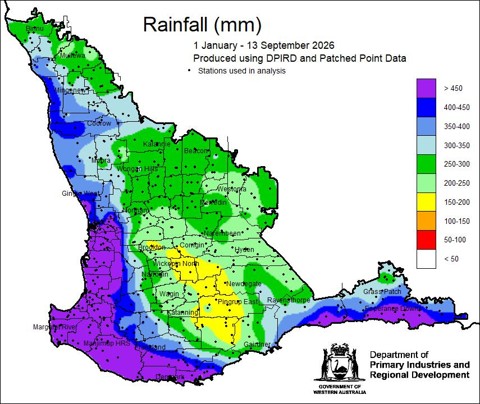
Figure 1. Rainfall (mm) from 1 January to 13 September 2026 for the SWLD. Coomalbidgup has the highest total of 534 mm and Kukerin has the lowest total of 158 mm.

Figure 2. Rainfall deciles from 1 January to 13 September 2026 for the SWLD. Indicating variable rainfall throughout the SWLD.

Figure 3. Plant available soil water map for the SWLD using rainfall up to 13 September 2026, uses the FAO crop factor method and represents the mean of ten soil types. The map indicates generally low levels of soil moisture.
Forecast
The October to December rainfall outlook from the Climate Copernicus website, which combines nine global climate models including the ACCESS model from the Bureau of Meteorology, indicates that above median rainfall is most likely across the SWLD (Figure 4). The wetter outlook is partly due to warmer than normal sea surface temperatures (SSTs) in the Indian Ocean, which can provide more moisture to spring and summer weather systems.

Figure 4. Probability of exceeding median rainfall for Australia in October to December 2026 from Climate Copernicus, which is a median of 9 climate models. Indicating below median rainfall is expected for the South West Land Division for August to October.
The El Niño in the Pacific Ocean is expected to persist into autumn 2027. An El Niño over spring/summer increases the risk of bushfires. The wetter rainfall outlook for October to December, may increase weed burden and allow a green bridge to persist into autumn 2027, potentially increasing the carry-over and spread of pests and diseases.
Temperature
In August, maximum temperatures were above average to very much above average across the SWLD. Minimum temperatures were average to above average across the SWLD. There were reports of frost damage in cereals, with Wickepin North recording 18 nights below 2°C, which is 9 more than the long-term average for August. September temperatures have been above average so far with temperatures recorded above 30°C in the northern grainbelt.
Outlooks for maximum and minimum temperatures indicate that conditions are likely to be warmer than normal for October to December 2026. There is a 40-70 per cent chance that maximum temperatures in October to December will be in the highest 20 per cent of the historical range, according to the Bureau of Meteorology’s ACCESS model (Figure 5).

Figure 5. Chance of October to December 2026 maximum temperature (for Australia) being in the highest 20% of the historical range. From Bureau of Meteorology’s ACCESS model
Additional information is available from:
- DPIRD: Weather stations
- DPIRD: Soil Water Tool
- DPIRD Rainfall to Date Tool
- DPIRD Seasonal Climate Outlook newsletter
- BoM: Rainfall totals for cool season 2025/26
- BoM: Rainfall outlook for the next week
- BoM: Seasonal Rainfall Outlook
- BoM: Australian Water Outlook
Geraldton Zone
The Geraldton port zone is very mixed with early sown crops in the areas where rainfall has been good having high grain yield potential, but the later sown crops on the light country where rainfall has been low have very poor yield potential. The best areas are now south of Mingenew and east towards the Buntine/Mullewa line. East of this line the crop yield potential falls away dramatically. Crops along the Three Springs/Carnamah/Coorow line, which were too wet during winter, have dried out and continued to get regular rain pushing grain yield potential up over the last month. Further west, south of Geraldton, crops on the lighter soils are struggling due to a lack of rain as are crops further east. Early sown crops around Yuna, Eradu and the Chapman Valley are good, although it falls away further north to Binnu and Ajana from lack of finishing rains.
Time of sowing is going to have a huge impact on final grain yield with the later emerged crops struggling to hit profitable yields. Crops on fallow, deep ripped and the better water holding capacity soils are going to be okay and will reach closer to long term average yields.
The majority of the lupins are in the southwest regions of the zone and yields are going to be good here. Canola is really variable and is the crop most affected by time to emerge with many of the later crops struggling to hit 1 t/ha. Canola crops are being desiccated and will be ready to harvest in a week or so. This early start to harvest is an indication of the sharp finish expected this season.
Kwinana Zone
Kwinana North Midlands
The zone is sharply divided by rainfall. The central and eastern areas are in better shape than the west for a change. The western areas missed out on critically needed rain in August whilst the central and eastern areas picked up useful falls that have saved the season.
The rain corridor running diagonally from Warradarge/Coorow through Watheroo and down to Bindi/Wongan has been quite good although south and west of that line the crop yield potential drops away quickly. The heavy country around Moora and back to Wongan is hanging in there with decent potential particularly on the ameliorated lighter soils. There is a very noticeable performance gap between the ameliorated and unameliorated country showing up this year.
The region had the potential to deliver similar yields to 2025, but now with the heat being turned on and limited subsoil moisture, grain yields will be closer to 2024, which is still an okay result for the region. With growth stages being a little ahead of rainfall equivalents, for their maturity timing it is providing some offset to the tighter finish.
Crops came out of 2025 into 2026 without the residual soil nitrate buffer that existed coming out of 2023 into 2024 and consequently crops looked lean on nitrogen at the end of August. With moisture now running out, the underdone crops will probably end up about square as yield potential drops off proportionally to the nitrogen requirement.
Lentil area in the central wheatbelt is going from strength to strength and based on the way most lentil crops look and interest from growers, lentils will continue to consolidate as a serious crop over the next little while in WA.
On the disease front, powdery mildew in wheat had started running up the plants and was being dealt with through fungicide applications, but with the weather turning drier and hotter, the season has done a good job of halting further progression. Barley powdery mildew has been increasing in the dominate varieties in recent years and it appears obvious from the high levels of infection that these varieties are on the wane. The same story is being found in other regions of the state.
Loose smut levels in barley are at the worst levels seen in a very long time. The seed crops that underwent head washing last year are the best performers. Succinate Dehydrogenase Inhibitor (SDHI) resistance for loose smut is suspected as it is in other regions of the state. Flag smut in wheat is at the worst levels seen for a long time.
Growers aggressively targeted sclerotinia in early emerged canola mid-season. Some had two sprays and the later crops received only one because the drying conditions have proven as good as another spray. This early application of fungicides looks to have had a positive impact on reducing upper canopy blackleg infection in the region.
Sclerotinia in lentils has been as bad as last year and is going to be an ongoing management challenge. The lupin crops that have a spray for sclerotinia are looking very good and yields should be very good. In Lupin crops that didn’t have a spray it’s pretty easy to find sclerotinia.
Diamondback moth has been present in canola crops all year and are now starting to build up in numbers. Green Peach Aphids numbers have been very high all year although the hot winds are now sorting them out. Russian wheat aphid, which was not so obvious earlier in the season, is now very obvious in hot spots in many cereals across a large area of the region. .
Mice are increasing in numbers where there was no baiting earlier in the year and are starting to cause damage. Areas that were baited have much lower numbers.
Kwinana South
The Kwinana South region is going to pull off a miraculous recovery from where it was last month due to the deep low pressure system that sat on top of the central portions of the zone in the last week of August. At the start of August crops had reasonable potential although subsoil moisture was non-existent and crops were living from hand to mouth on light rainfall events. Grain yield potential was sliding by the day and for many growers it was starting to look pretty grim. The largely unforecast rain reset grain yield potential and effectively added a few million tonnes of grain to the state’s total.
The western rim of the zone and the dry strip in the southwest of the zone were not so lucky with rainfall seeing totals closer to 20-30 mm rather than 50-60 mm. The rain did reset potential in these areas, although it was more to hold potential than increase potential.
Frost has not been an issue with cereals although many early sown canola crops have large gaps in pod fill which may be due to factors other than frost. Even so, the extent of this lost potential is going to put a lid on the canola tonnage in the region.
Barley crops are going to be very good with plenty of 4 t/ha crops on the cards. The later sown wheat is going to be good, although some is still flowering which is a bit late for a year like this with the heat cranking up and low subsoil moisture reserves.
Kwinana North East
It is going to be a very good year right across the zone and if the forecast storms arrive in the next few days to top up grain fill, it could be a very, very good year.
Most crops are essentially done now, with harvesting set to get underway on canola in about three weeks’ time, with oats and barley following soon after. Wheat has chunky heads this season. Normally the zone struggles to get to adequate grain fill and ends up with lightweight grain and high screenings. This year it looks like the cereals will have good grain weight, which is where a lot of the extra tonnes will come from.
Protein levels in cereals are expected to be low as a result of low applied nitrogen rates and the dilution effect that comes with high yields. The combination of high nitrogen prices and risk resulted in many crops being now underdone for nitrogen.
It is going to be a very big year for barley in the region with plenty of 4 t/ha crops on the cards. The early sown wheat is very good, and the later sown crops have benefited from the reasonably mild grain fill temperatures up until now.
Canola doesn't look as good as expected, possibly due to some nitrogen limitation and frost at the start of grain fill. In saying this, there will be plenty of 1.5-2.0 t/ha crops around in the low rainfall regions this year. Upper canopy blackleg is increasing as a yield detractor due to tightening rotations.
Diamondback moth are increasing in numbers and it’s going to be a race for the crops to finish before numbers get out of hand. Often when numbers are increasing during grainfill, the damage they can inflict in the last few weeks before crops dry off can be underestimated.
Albany Zone
Albany West
The west Albany region is heading for very mixed results this harvest reflecting the stark differences in rainfall from west to east. The western areas that did not suffer from waterlogging will be as good as any record years recently, while in the areas that have been light on rainfall all year and had a later start, grain yields will be at very much the lower end of what is normally produced. In the worst areas around Pingrup, Kukerin, Nyabing canola has been particularly impacted and in a lot of cases will struggle to hit 0.5 t/ha. The usually reliable areas around Gnowangerup and Ongerup will fair slightly better but will still struggle to hit profitable yields.
Decision making around nitrogen applications has been very difficult for growers and their advisers this year, to match grain yield potential with rainfall and fluctuating fertiliser prices.
The western area around Kojonup and Broomehill was bordering on being waterlogged in July, but that has subsided now and growers there are going to have at least an average year. Some paddocks that struggle in wet seasons due to waterlogging will break records in this drier year and may actually be the best-performing paddocks this year due to the drier conditions.
In the strip west of the Arthur River-to-Broomehill line most crops will turn out reasonably well, and with the benefit of hindsight would have benefited from additional nitrogen. In contrast, the eastern areas around Broomehill have potentially received too much nitrogen relative to how rainfall has tracked.
Conditions in the region did improve slightly since the late August rain event, but yield potential is still firmly constrained and water use efficiency calculations make it very clear what is realistically achievable given available moisture. The recent good run of years has meant grower expectations in winter and early spring have had to be wound back where yield potential simply did not justify the expenditure
Scald in barley is becoming quite prevalent and where there were isolated cases last year, it is now widespread. Net Type Net Blotch is also increasing in incidence. There is also some leaf rust appearing where previously it was more confined to the south coast region. It appears that variety tolerance to these diseases may be breaking down quicker than first thought.
Russian wheat aphid are also rearing their ugly heads more this year as they have further north in the state, infecting both wheat and barley.
Albany South
Crop yield potential in the region has improved overall since the last Crop Report with most areas in the region receiving more than 50 mm in the past month. The canola particularly has picked up and recovered some grain yield potential that was lost from frost during the early stages of flowering.
Barley continues to crack along, and the later emerged wheat paddocks have improved in potential as well. The region will still need a few more rainfall events over the next month to get yields of the later emerged crops up to average. All of the early emerged crops now have very good grain yield potential.
Albany East (Lakes Region)
The eastern and northern portions of the region continue to be in good shape, although crop grain yield potential falls away in the south and western areas. These regions were later to emerge and are well down on year to date rainfall, with many sitting on decile 1-2 rainfall totals. Even in those areas where there have been some top up rainfall events recently, crop maturity has progressed too far to realistically achieve long term average yields.
The better areas will be solid without breaking records. The lack of any significant frost is once again going to be a good thing for the area and will contribute to keeping tonnage for the region up.
Esperance Zone
Harvest is expected to get underway around 10 October, starting with barley and some canola. The canola across the zone is done with flowering and is just beginning to change seed colour. The hot winds being experienced now will push maturity along and regions further south will be into harvest before long.
Barley is in the advanced stages of grain fill in the north and wheat in some cases is still flowering or is only part way through grain fill.
The August rainfall was sensational across the zone with 55 to 120 mm received through the Mallee right up to Salmon Gums. This fell in two main events, one at the start of the month and one at the end of the month, which was ideal. There were a few heavy dumps of rain that resulted in some paddock damage and waterlogging, but the rain did a lot more good than harm.
There has been very minimal frost through the Mallee and further south.
Nitrogen rates are expected to be the biggest limiter of yield potential with less willingness to spend on nitrogen this season than in previous years, particularly in the lower rainfall environments. Some low protein wheat is expected as a result of this.
The grain yield gradient through the zone from the northern Salmon Gums area looks to be tracking at about 3 t/ha plus for barley and 1.5 t/ha canola. Further south into the core Mallee region, yield potential increases significantly. The severely waterlogged country closer to the coast around Coomalbidgup, Condingup and up to Gibson will see heavily reduced yields from area losses and root damage on sandplain soils. The strongest yield potential is through the middle of the zone around Grass Patch, Cascade and Beaumont.
Budworm in legumes and some canola are starting to become active, as are isolated Diamondback moth populations.
On the disease front it has been one of the worst years for barley leaf rust with many growers getting caught out trying to control it. Powdery mildew on the south coast was not as bad as last year but was still pretty bad in some areas. Sclerotinia in canola has been widespread, fuelled by the warm moist conditions during flowering, and quite noticeable in the canola-on-canola paddocks. Upper canopy blackleg is becoming more apparent in the Mallee and many consider it as the main disease limitation in in canola in that environment.
All the pulse crops are looking good with lentil, faba bean and pea yields expected to be at the upper end of historical yields. Chocolate spot was evident in most faba bean crops, particularly where fungicide application timing was a little late.
With storms forecast over harvest, growers are again reconsidering what wheat varieties they will hang onto for next year with some of the better yielding newer varieties seeing weather damaged grain from humid or wet conditions at harvest.
Harvest labour is a significant concern as it is across the grainbelt, with many overseas casuals still in limbo months after applying for visas and no word about the likelihood of if and when they may be allowed into Australia.